


I was chatting with a marketing lead at a growth-stage fintech startup recently. They were excited about a new channel producing customers at the lowest CAC they’d ever seen. The unit economics looked unbeatable. They were already building a case to shift more budget toward it.
I asked what those customers look like at month six. They hadn’t thought that far out.
I get it. Low CAC feels like proof that something is working. Your board loves it. Your investors nod. It validates the strategy. But CAC only tells you what you paid to get someone through the door. It says nothing about whether they should’ve walked in.
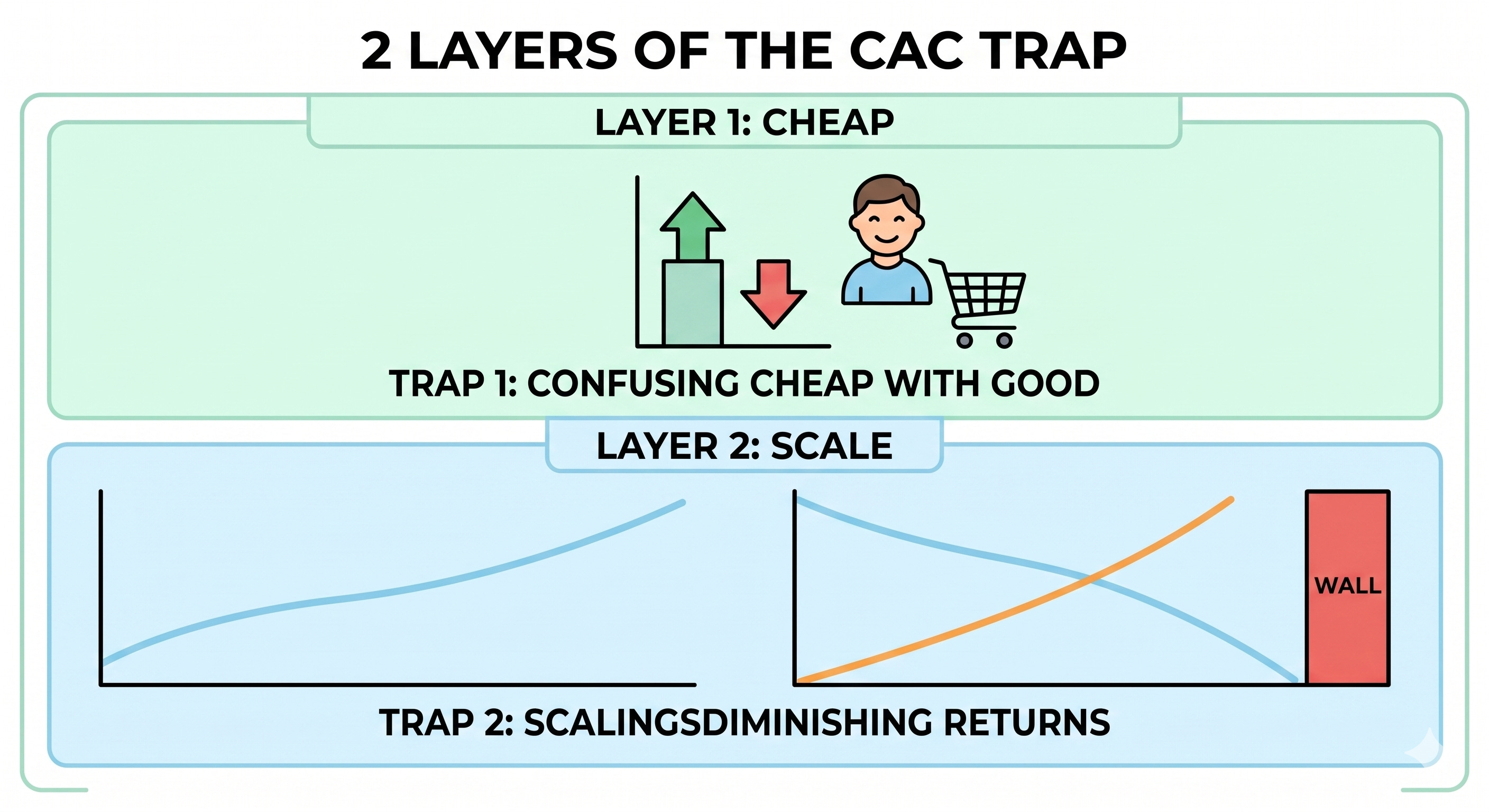
That’s the CAC trap. And it has 2 layers. Most teams catch the first one. Almost nobody catches the second.
Trap #1: Confusing cheap with good.
An efficient channel gets you a customer for less money. An effective channel gets you the right customer. Sometimes those overlap. Often they don’t.
A channel can produce volume that looks demographically right but is behaviorally wrong. The profile matches your target user on paper. Age, income, geography, all checks out. But the intent doesn’t. These customers signed up because of a promotion, a cashback incentive, or because your ad caught them while they were comparison shopping. They activated. Maybe they even used the product once or twice. But they were never looking for what you actually built.
They churn, not because your product failed, but because they were never really looking for it.
The cost of that mismatch doesn’t show up in your CAC. It shows up six months later in your churn, your support tickets, and your LTV.
And the annoying part is that on day one, a mismatched customer and a great customer look identical. Same signup flow, same onboarding steps, same early activation metrics. The divergence happens slowly. By the time you see it in the data, you’ve already acquired a few thousand more just like them.
Meanwhile, the channel where you’re paying significantly more per customer is quietly producing your best cohort. Higher engagement. Better retention. These customers understood what they were signing up for before they clicked. The LTV-to-CAC ratio tells a completely different story.
The fix seems obvious: look at LTV, not just CAC. Track cohort quality by channel. Most growth teams eventually get here.
But that brings you to the second trap.
Trap #2: Scaling past the point of diminishing returns.
You’ve identified your highest-LTV channel. The cohort data is strong. The ratio is exceptional. So you pour more money into it.
Every channel has a finite pool of high-intent users. The early performance you’re scaling against came from reaching people who were already close to your product. They had the problem, they were actively looking, and your channel put you in front of them at the right moment.
Once you exhaust that core and pump more capital in to maintain volume, you start reaching a different audience. People who are adjacent to your target user but not quite there. People who might be interested but aren’t actively searching. People who need more convincing, more touches, more incentive to convert.
Your marginal CAC climbs because you’re fighting harder for each incremental customer. Your marginal LTV drops because those customers care less about your core product. The customers you acquired at $40 when the channel was humming now cost you $80, and they retain like the $10 customers from the cheap channel you wisely moved away from.
Your dashboard won’t show this.
Blended averages stay green because historical performance masks what’s happening at the edges. Say you acquired 1,000 great customers at $40 and then 200 mediocre ones at $80. Your blended CAC is $47. Looks fine. The LTV blend still looks healthy because those first 1,000 are pulling the average up. Everything on the weekly report says keep going.
But your latest ad dollars could be losing you money and you wouldn’t know it until the cohort data catches up. In fintech, that can take 6 to 12 months.
So what do you actually do?
The discipline is 2 things, not one.
Figure out what a “good” customer actually looks like beyond demographics. What’s their activation behavior in the first 30 days? What’s their engagement at day 90? Which channels produce customers who actually do those things? Once you know this, you can evaluate channels on what matters instead of what’s easy to measure.
Know where each channel’s marginal return turns negative. Track unit economics by channel over time, not just in aggregate. Plot your CAC and LTV by acquisition month for each channel. If you’re spending more each month and the cohort quality is declining, you’ve found the wall. The answer isn’t to abandon the channel. It’s to cap it where the economics still work and put the marginal dollar somewhere else.
Both of these require you to slow down when everything is telling you to speed up. A channel is working, the board wants growth, and the most natural thing is to double the budget. Saying “we should spend less on our best channel” is a weird argument to make in a growth meeting. But it’s often the right one.
The next time someone celebrates a record-low CAC or demands you double the budget on a winning channel, ask 2 questions:
What does that customer look like at month six?
What is the next customer going to cost us?
The first question protects you from trap #1. The second protects you from trap #2. Together, they’re the difference between growing and growing profitably.