


It took me longer than I’d like to admit to get good at startup marketing.
Being good at marketing was never the problem. What took time was realizing how much of my success depended on things outside the marketing dashboard, and figuring out the best way to take charge and tackle them myself.
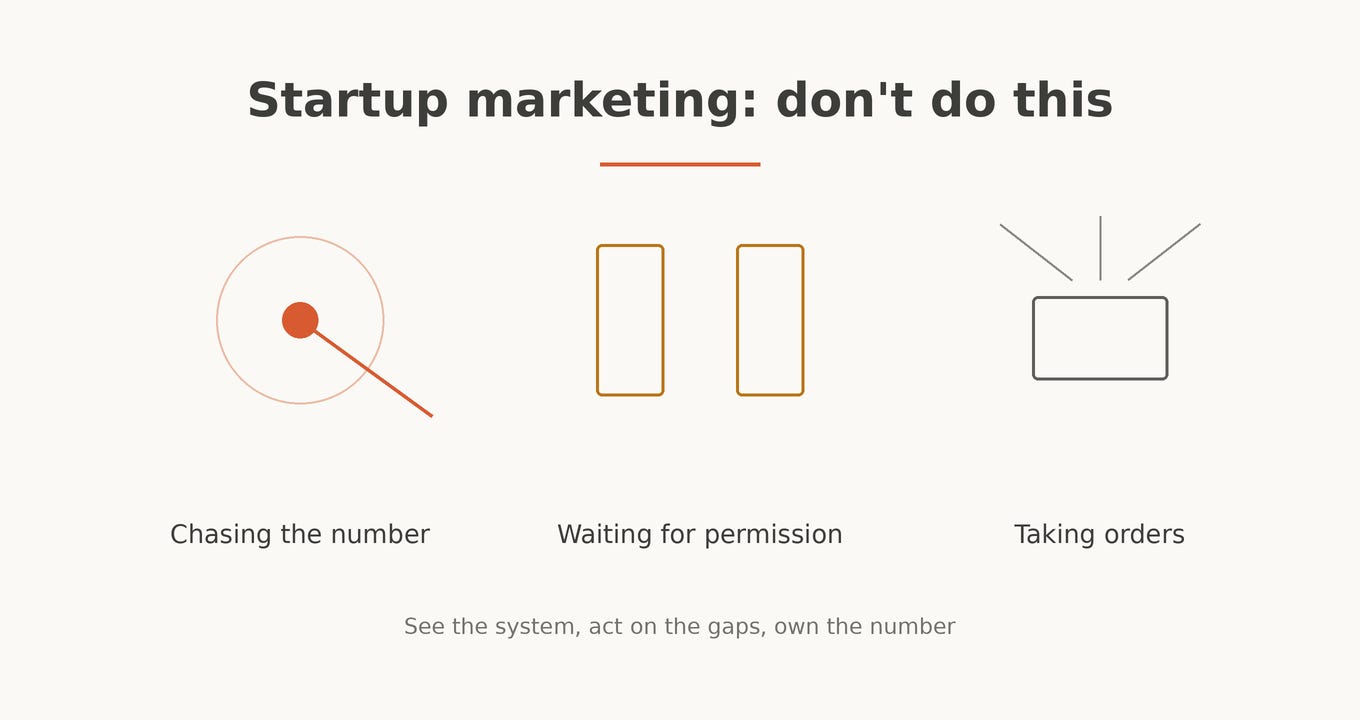
When I look at the startup marketing teams that miss goals, mine included, it usually comes down to one of three things.
Chasing the number without seeing the system. You hit every marketing metric while the addressable market shrinks or sales stops closing, and keep pushing hard on a lever that stopped mattering.
Waiting for permission while the system breaks. Marketers wait to be told to own the gaps while the business fractures in slow motion because nobody steps in.
Taking orders instead of owning the number. Marketing becomes the place every other team sends requests, and the function turns into a service desk that stays busy and moves nothing.
You need all three at once. See the system, act on the gaps, own the number.
Over the last few years I have worked with several founders and helped some of them through fundraising and exits. Here are the 8 things I learned the hard way.
1. Pressure-test your target goals in month 1
Whatever target you inherit, someone set it, and there’s a good chance it came out of a fundraising deck or a boardroom exercise without much real math behind it. Pull it apart before you own it. Probing an inherited number in your first month takes nerve and you’ll often be doing it without extensive data behind it. Do it anyway. If it holds up, you understand the business better than you did. If it falls apart, you found your biggest threat in week two instead of month ten.
2. Continuously watch the broader assumptions under the bet, not just the marketing on top of it
We recently went into a credit card partnership that looked strong. The marketing wasn’t the problem, we ran it well. The problem was that the addressable segment the whole thing depended on was shrinking rapidly given macroeconomic changes, and in a short time it wasn’t big enough to work. You can execute beautifully while the ground under the bet gives way. Track the things that aren’t on your dashboard but decide whether your work matters. Is the segment growth still there? Is the addressable market headed in the right direction? Has anyone new changed the competitive math?
3. Capture existing demand before you spend on creating it
Burning early money on top-of-funnel brand work because it feels like real marketing is an expensive way to stay busy. Capture pays now. Creation pays later. Until you can turn a dollar of spend into growth the company can see, brand building is a bet you haven’t earned yet. Prove the capture, then you get the room for the bigger, slower swings.
4. Own positioning, because no one else will
Positioning isn’t a marketing deliverable you tick off. It’s a leadership call, and it sits in the empty space between product, sales, and the exec team. Leave it there and sales invents a new pitch on every call, product builds for a user who doesn’t exist, and you end up marketing something the market doesn’t recognize. If you don’t force the issue, it doesn’t get forced.
5. When they say marketing isn’t working, diagnose it, don’t defend it
When the exec team says marketing is broken, the reflex is to pull up the campaign metrics and defend the work. It’s the wrong move. Most of the time “marketing isn’t working” means something upstream gave way. The pricing is scaring people off, sales conversion dropped, the product doesn’t do what the promise says. The job is to find the actual bottleneck, even when it’s not marketing, not to protect the word on the org chart. The people who diagnose instead of defend end up with more authority, not less.
6. Concentrate your budget in 2-3 channels until the economics are undeniable
Spreading early budget across six channels feels productive and teaches you nothing. Take the same money and go deep on 2-3 until you have unit economics you can’t argue with. If you can’t prove the model in a concentrated spot, scaling reach just multiplies what isn’t working.
7. Translate the founder’s ask, and hire for ownership
When a founder asks for a campaign or a launch, the thing underneath the ask is usually growth, not the tactic itself. Take the tactic literally every time and marketing becomes a service desk. The more useful response is to work back to the number it’s meant to serve, and say so. Same instinct when you hire. The first hire is the operator who takes a whole messy outcome off your plate, not five specialists who fill an org chart. I have found that it is easier to teach craft than to teach someone to own the outcome.
8. Have a strong opinion, but keep the door open
A strong point of view is what gets you taken seriously. Show up without one and you’re the order-taker again. So form the opinion, say it plainly, and be willing to be the one in the room with a clear position. But always keep the door open for a contrarian view and a challenge to your assumptions, especially with founders. Founders are often right and you’re often still learning the business. What’s worked for me is to state my view with conviction, while sharing the assumptions underneath it.
The real job
None of this is about running campaigns. The job is working out what has to be true for the company to hit its number, then getting the whole go-to-market effort to line up behind it. The marketing sits downstream of that.