


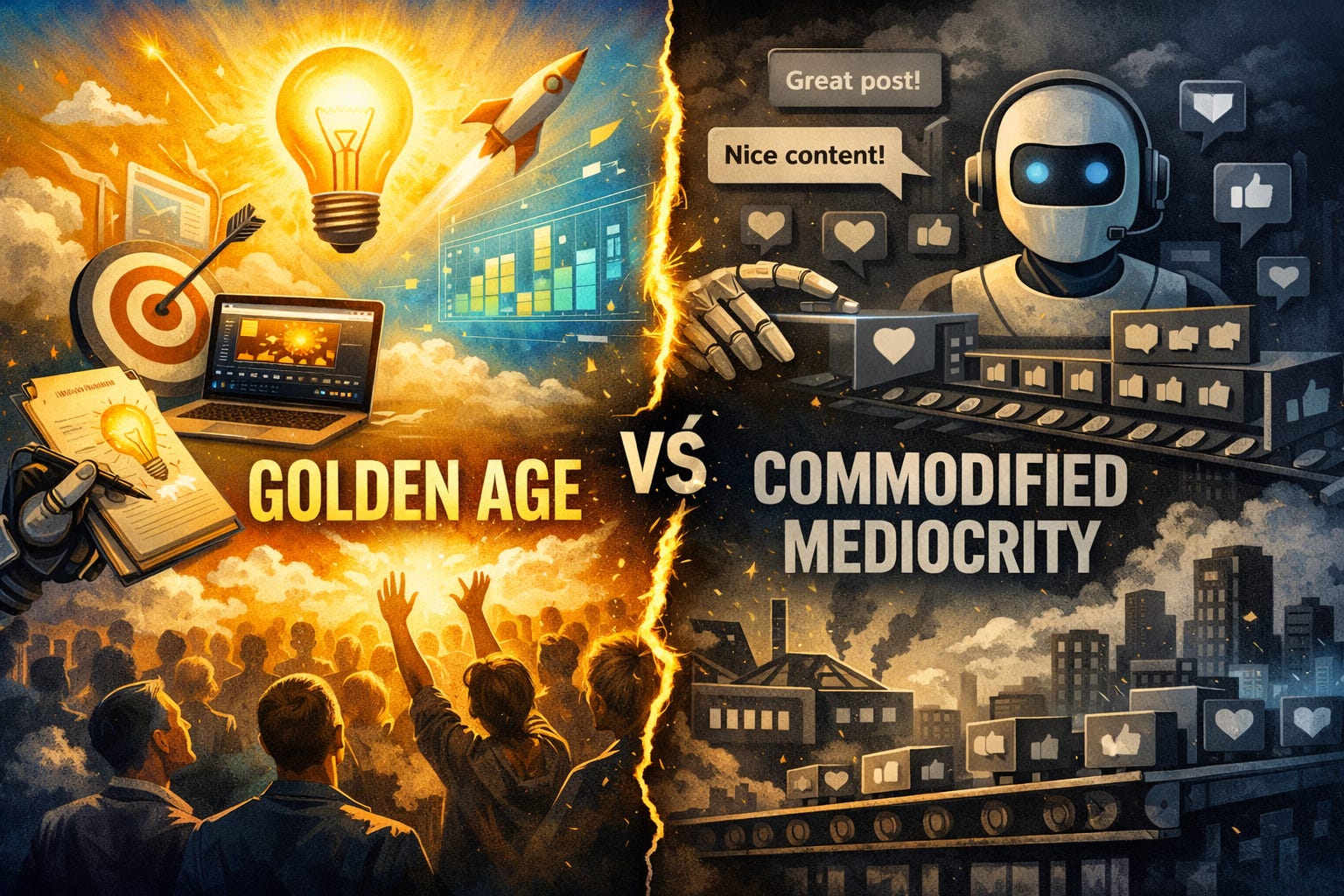
Currently I find myself wrestling with a profound paradox in the world of marketing. We are simultaneously standing on the precipice of a golden age and hurtling towards a cliff of commodified mediocrity. The choice, as always, is ours.
1. We’re Entering a Golden Age
I genuinely believe this with every fiber of my being. For the first time in history, individual marketers and small teams have access to tools that, until very recently, were the exclusive domain of large agencies with massive budgets. Think about it:
Professional-Quality Content: AI-powered design tools, video editors, and sound studios can now transform a raw idea into a polished asset in minutes, not days or weeks. High-fidelity visuals, compelling narratives, and immersive experiences are no longer budget-prohibitive.
Sophisticated Campaigns: Advanced analytics, predictive modeling, and hyper-segmentation are accessible via intuitive platforms. You can run A/B tests on a grand scale, personalize messaging with unprecedented precision, and optimize spending in real-time.
Audience Reach: The sheer number of platforms and precise targeting capabilities mean that niche communities, once impossible to reach directly, are now just a few clicks away.
This is true democratization. The barrier to entry, in terms of production and distribution, has never been lower. This means that better ideas, more authentic voices, and genuinely innovative approaches now have a fighting chance to win, regardless of the size of the marketing budget behind them. It’s exhilarating.
2. But We’re Squandering It
And yet, my excitement is tempered by a growing unease. We’re witnessing a disturbing trend: the commodification of human connection.
Take LinkedIn, for example. What was once a professional networking hub is increasingly becoming a battleground for automated engagement. AI agents are being released to post comments as you, at scale. They’re designed to automate liking, automate community participation, and mimic human interaction.
This isn’t democratization; it’s a race to the bottom. It’s the scaling of inauthenticity. Here’s why this kills me:
Diminished Returns: When every comment or “like” feels machine-generated, the value of any engagement plummets. It’s like a conversation where everyone is reading from a script.
Audience Disengagement: People come to platforms for human connection, for genuine insights, and for meaningful dialogue. When that experience is polluted by algorithmic noise and superficial interactions, they don’t engage more; they leave. They grow cynical.
Lost Opportunity: We’re using incredibly powerful tools to make marketing worse, not better. Instead of amplifying our craft, we’re automating away its soul.
We are, in essence, squandering the golden age by focusing on scale over substance, quantity over quality, and automation over authenticity.
3. Strategy is the Moat; Trust is the Currency
In this landscape, where the cost of content production has dropped to near zero, two things become paramount: strategy and trust.
When anyone can generate a high-quality video, a polished graphic, or a “thought leadership” post in seconds, content alone ceases to be a competitive advantage. If the barrier to creating is gone, the only thing that retains its value, and indeed, becomes exponentially more valuable is the unique strategic insight that guides that creation, and the human trust behind its delivery.
Think of it this way:
Strategy as the Moat: In a world awash with AI-generated everything, your unique perspective, your deep understanding of your customer’s unarticulated needs, and your ability to craft a truly differentiated message are the only moats left. AI can execute, but it cannot genuinely innovate strategy based on human empathy and foresight. We must use AI to handle the noise, process data, and execute tasks so we can focus on the signal – the core strategic challenges that truly move the needle. This means more time for deep customer interviews, market analysis, and creative problem-solving.
Trust as the Currency: When audiences are bombarded by automated voices, a genuine, human voice becomes incredibly rare and valuable. Trust is the rarest currency in an era of digital impersonation. If your audience suspects a machine is talking to them, if they feel manipulated by a bot, you’ve already lost. Our job in 2026 isn’t to merely optimize for clicks or impressions; it’s to optimize for connection, for rapport, and for belief. Especially in sectors like fintech, where I operate, trust isn’t just a nice-to-have; it’s the bedrock of every single transaction and relationship.
The Choice Is Ours
AI will either amplify your craft or replace it. This golden age only happens if we choose wisely.
Do we use these tools to free up time to genuinely connect with communities, listen to customers, and solve real problems? Or do we use them to scale mediocrity and pollute the landscape with inauthentic noise?
Marketing has always been about connecting people to ideas, to solutions, and to each other. That hasn’t changed in 2026.
So when you pick up these tools tomorrow, ask yourself: am I building strategy and trust? Or am I scaling noise?
One path looks golden. The other is just a race to the bottom.