


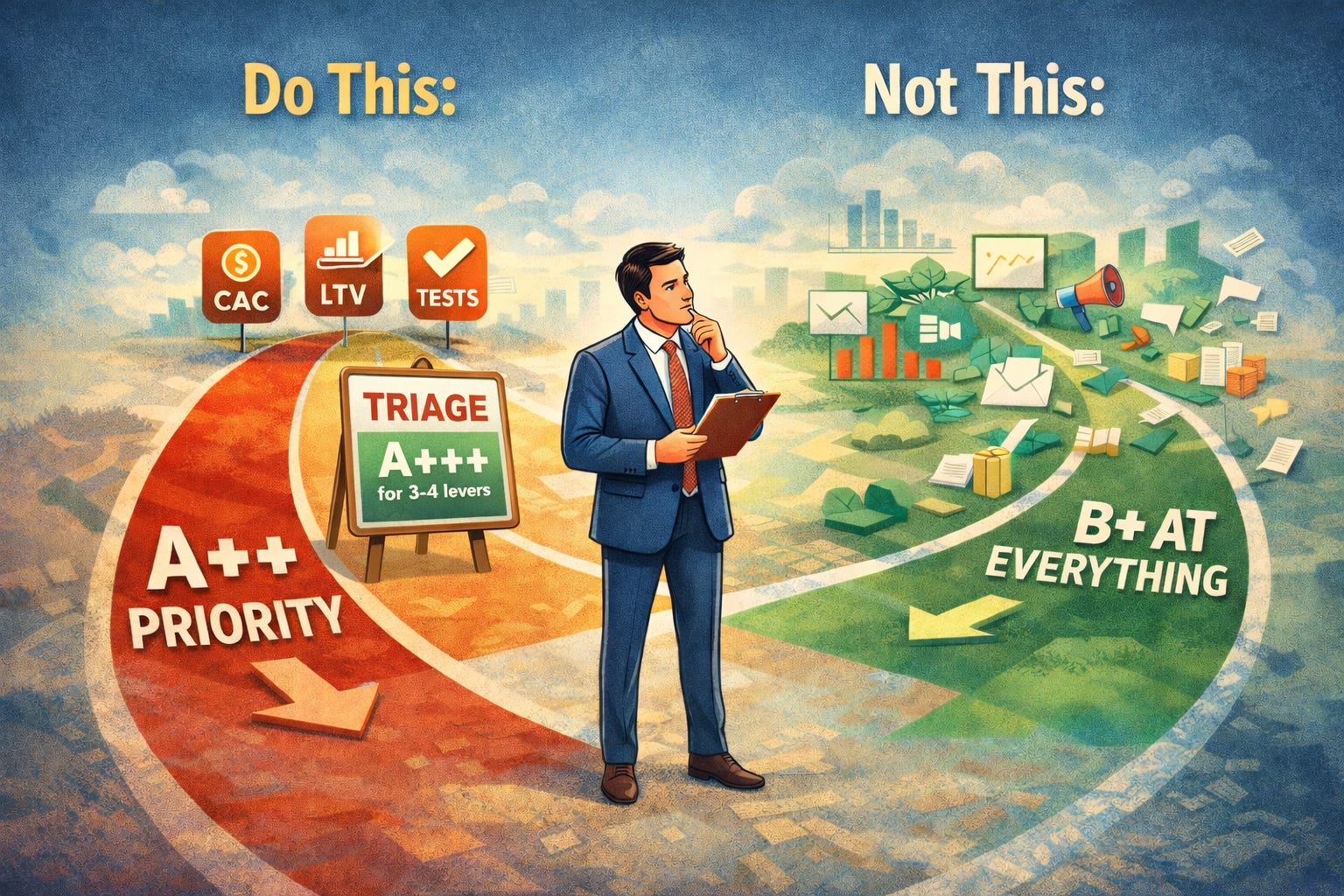
A few years back, I made a decision that felt responsible at the time. Setting up the marketing org for a fintech startup embedded in a larger firm, I looked at my mandate: acquire customers, build brand, drive engagement, optimize retention. And I thought, “I’m going to be great at all of it.”
So I built a plan that touched everything. Content marketing, paid search, brand partnerships, organic social, email nurture sequences, product launches, brand awareness campaigns. It was comprehensive. Logical. Balanced.
By every metric, we performed. Hit our targets. Shipped campaigns on time. Our analytics dashboards glowed green.
But here’s what nobody tells you: being B+ at ten things doesn’t move the needle. You move the needle by being A++ at two.
That fintech marketing org taught me the most valuable lesson I’ve learned: ruthless prioritization. Picking 2-3 bets that actually matter. Then doing those exceptionally well while letting everything else ship at 70%
The Illusion of Balance
There’s something deeply appealing about balance. It feels fair. Professional. Like you’re taking your job seriously by caring equally about everything.
It’s also how you waste 18 months of effort and human capital.
The brutal truth of high-growth environments is this: results follow a power curve, not a bell curve. Roughly 90% of your outcomes come from 2-3 critical levers. Everything else is noise masquerading as work.
Most of the stress in marketing organizations doesn’t come from the hard problems. It comes from trying to give 100% to things that deserve 20%. You’re running yourself ragged optimizing campaigns that have a ceiling of 15% impact, while your biggest revenue driver sits in the corner getting your leftover attention on Friday afternoons.
Ruthless prioritization is the antidote. It’s the discipline to ask: what are the 2-3 things that, if we nail them, everything else becomes easier? And then: everything else gets shipped at 70%.
Four Levers for 2026
This isn’t a ten-point plan. This is what actually matters this year, assuming your job is to move real business metrics and not win planning meetings.
1. The P&L is Your Creative Brief
Stop thinking about marketing deliverables. Start thinking about unit economics.
Every dollar you spend needs to connect to either CAC (Customer Acquisition Cost), LTV (Lifetime Value), or something that feeds those metrics. If you can’t articulate how a project moves one of those by X%, it doesn’t deserve your peak mental energy.
Brand awareness still matters. Partnerships still matter. Long-term positioning still matters. But here’s the honest truth: if you’re a growth-stage company, brand awareness that doesn’t eventually move CAC is sitting below the line. It’s not eliminated. It’s ranked.
I learned this the hard way in another fintech setting. We did solid work on brand building and partnerships, but we treated them as equally important as the levers directly impacting customer acquisition cost. That was the mistake: not doing them, just ranking them too high
Spend your obsession on what moves unit economics. Everything else? Ship it competently and move on. Do it well enough that it doesn’t actively hurt you, then redirect your best people to the levers that actually move the business.
2. Orchestration Over Automation
We’re at an inflection point. The old marketing stack was a series of independent tools firing in isolation. Your email platform didn’t know what your paid ads were doing. Your SMS campaigns didn’t know your website had 40% cart abandonment.
2026 is the year of orchestration: channels that talk to each other in real-time.
CAC spikes in paid search because competition got heavier? Your email offer intensity adjusts automatically. Open rates drop across the board? Retargeting tests new creative angles. Cart abandonment rises unexpectedly? SMS timing and messaging shift to catch people at a different moment.
We’re not fully agentic yet. But smart triggers and cross-channel intelligence have made a quantum leap in the last 18 months. The difference between last year’s marketing stack and this year’s isn’t incremental. It’s the difference between playing chess and conducting an orchestra. One reacts. The other anticipates.
The organizations that win 2026 won’t be the ones with the fanciest tools. They’ll be the ones that actually connect their tools and let them communicate.
3. Speed of Learning is Your Competitive Moat
Marketing playbooks have a half-life, and it’s getting shorter.
In 2020, a winning playbook stayed effective for about 18 months. By 2026, that’s compressed to 6-9 months. Maybe shorter depending on your category.
This changes everything about how you should operate.
If your strategic approach is to spend months perfecting a campaign, test it meticulously, then roll it out, you’re already obsolete by the time you launch. The market moved. Your competitors tried something new. The window closed.
The winning move is to shift from polish to velocity. I’d rather test 10 imperfect ideas at $100 each than 2 polished ideas at $500 each.
Yes, some will fail. That’s the point. You’ll learn faster. You’ll find what actually works before your competitor finishes their perfect PowerPoint deck. You’ll compound advantage in real-time.
This is where ruthless prioritization becomes a speed tool, not just a focus tool. By ruthlessly cutting the non-essential, you free up cycles to test more, learn faster, and adapt before the market shifts beneath your feet.
4. Decide Faster (Once the Levers Are Clear)
The highest performing teams I have worked with make most decisions quickly, then course-correct.
Most decisions are reversible. Your instinct to wait for perfect information isn’t prudence. It’s disguised risk aversion.
The hard work is upfront: doing the ruthless prioritization, identifying your 2-3 make-or-break levers, and obsessing over those until you’re confident. Once that’s locked, everything else should move fast.
Should you test that new channel? If the downside is limited and the upside compounds, ship it. Should you shift budget allocation? If it moves the needle on your primary lever, yes. Should you kill that campaign that’s only 10% effective? Immediately.
The organizations that feel slow aren’t slow because of lack of talent. They’re slow because they apply the same decision-making framework to everything. Big bets get the same rigor as small ones. Mission-critical levers get the same scrutiny as nice-to-haves.
Invert that. Spend 80% of your decision energy on the 2-3 levers. Everything else? Decide in a meeting, ship it, measure it, iterate or kill it.
The Real Skill: Knowing What Not to Do
The marketing industry trains you to say yes. Say yes to partnerships. Say yes to new channels. Say yes to creative requests. Say yes to “good opportunities.”
Leadership, especially in growth companies, is about saying no with confidence.
And not the “no, we don’t have resources” kind of no. The “no, this isn’t moving our primary levers” kind of no.
When we set up that fintech marketing org trying to be great at everything, nobody complained that we weren’t good enough at social media or partnerships. But we also didn’t move the needle on acquisition cost or unit economics the way a focused org would have. We were competent. We weren’t exceptional where it mattered.
That’s the gap.
Your 2026 Playbook
Identify your 2-3 make-or-break levers. The ones where if you win, the business wins.
Obsess over those at the highest level of polish. Put your best people there. Spend your decision energy there. Measure relentlessly.
Everything else? Ship it at 70% and move on.
You’ll move twice as fast. Your team will feel less stressed. And here’s the thing nobody expects: your overall output will be better. Because focus amplifies. And velocity generates compounding returns.
Most of your marketing plan doesn’t matter as much. The ruthless prioritization does.