


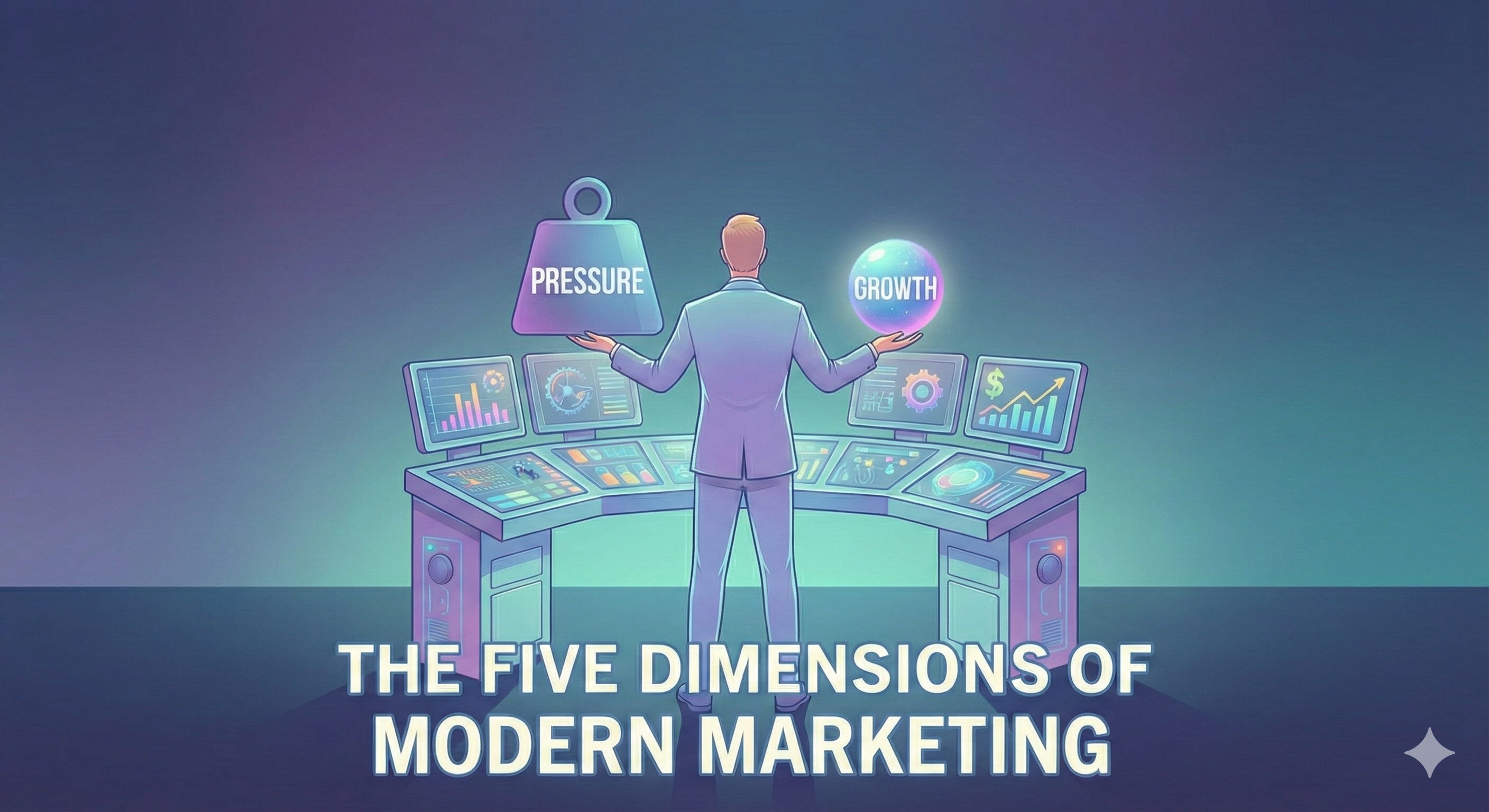
The pressure on marketers is intense. Walk into any growth-stage board meeting, and you’re the fulcrum. CEO wants a unifying vision. Sales wants closing pipeline. Product wants adoption. Finance wants efficiency proof.
A lot of this pressure manifests in top-down mandates we’ve all heard: “Do more with less.” “Scale faster.” “Prove the ROI.”
I’ve never subscribed to the idea that marketing is just about “creative.” For me, marketing has always been about business outcomes. It is a growth function, plain and simple. But the complexity required to deliver that growth has exploded. The channels are saturated, the algorithms are opaque, and the customer is more skeptical than ever.
To survive this weight and deliver real growth, we need a new playbook. The leaders who are winning right now have evolved. We have to operate across five distinct dimensions simultaneously.
1. The Chief Orchestrator
There is a dangerous tendency in our industry to solve problems by swiping a credit card. We buy a tool for email, a tool for social, a platform for ABM, and a dashboard for analytics. We end up with a “Frankenstein stack.” Powerful pieces that don’t talk to each other.
The modern marketer must be the Chief Orchestrator.
We have to build the stack to serve the strategy, not the other way around. It requires a systems-thinking approach where we wire GenAI, CRM data, and customer journey maps together. The goal is to ensure that intelligence flows through the system. If Sales doesn’t know what content a prospect consumed before they booked a demo, that’s an orchestration failure.
2. The Small Bets Scientist
I live by a principle that has saved me more budget than any negotiation tactic: I’d rather run 4 tests at $25 than one test at $100.
This is even more applicable in the age of AI, where it’s not always clear which bets will pan out. But here’s the key: all experiments need to be hypothesis-driven and ladder up to the broader strategy. If they don’t, you aren’t doing useful science. You’re just creating chaos.
Today, we have to operate like scientists. The goal isn’t to be right immediately. The goal is to be less wrong faster than the competition. We need to stop trying to perfect the launch and start perfecting the feedback loop. This requires a cultural shift. You have to build a team that is comfortable with failure, provided that failure happens quickly and cheaply. If the hypothesis is wrong, we want to know by Tuesday, not by the end of Q3.
3. The Pivot Master
This is the hardest dimension because it requires a massive ego check.
To be agile, you need strong convictions but loosely held opinions. We all have “pet projects,” ideas we fall in love with because they feel smart or innovative. But when the data says “stop,” you have to stop.
I’ll give you a real example from my own experience. I was once leading a project focused on hyper-localization. The hypothesis was solid: if we showed customers imagery specific to their city, they would convert at a higher rate. If you were in San Francisco, we showed you the Golden Gate Bridge. If you were in Santa Monica, we showed you the Ferris Wheel.
I loved this project. It felt sophisticated. It felt personal. I was ready to double down on the tech required to swap the images dynamically. But we ran the early experiments, and the data was brutal. It was flat. The localized imagery wasn’t moving the needle on conversions at all. Customers didn’t care about the bridge.
The “old me” might have tried to force it, tweaking the design because I wanted my idea to work. But the role demanded I pivot. We pivoted to testing headlines instead. The lift was immediate. It wasn’t the pictures. It was the words. Strong conviction combined with agility is a competitive advantage.
4. The Human Operator
In our rush to be data-driven, it is easy to get lost in the algorithms. We stare at dashboards, open rates, and attribution models until we forget what we are actually doing.
We are dealing with humans. Technology gives us reach, but empathy is what creates the connection. I see too many marketers obsessing over the “how,” how to track the user, how to retarget them, while ignoring the “why.”
If you don’t understand the visceral emotions driving the purchase, the tech doesn’t matter. Even in B2B fintech, you aren’t selling to a faceless corporation. You are selling to a finance leader who is likely overworked, worried about compliance, and just wants a solution that makes them look competent to their boss. If your marketing doesn’t speak to that human reality, you’re just adding to the noise.
5. The P&L Owner
This is the shift that feels hardest of all. We have to speak Finance as fluently as Creative. Historically, many companies viewed marketing as an expense, a tax you paid to stay relevant. Expenses get cut when times get tough.
We have to operate as P&L owners. Marketing is a capital investment that needs to show a return. I approach my budget the same way a portfolio manager approaches a fund. Every dollar deployed needs a thesis. Is this driving efficiency? Is it driving LTV? Is it shortening the sales cycle? If I can’t walk into the CFO’s office and explain how my spend is directly impacting the company’s runway and revenue, I haven’t done my job.
The Hybrid Future
The marketers who will thrive in the next decade won’t fit into a neat box. They will be part technologist, part scientist, part strategist, and part psychologist.
It is a demanding evolution. It requires us to be constantly learning and constantly adapting. But it is also the only way to build something that lasts.
The pressure is real. But so is the opportunity.