


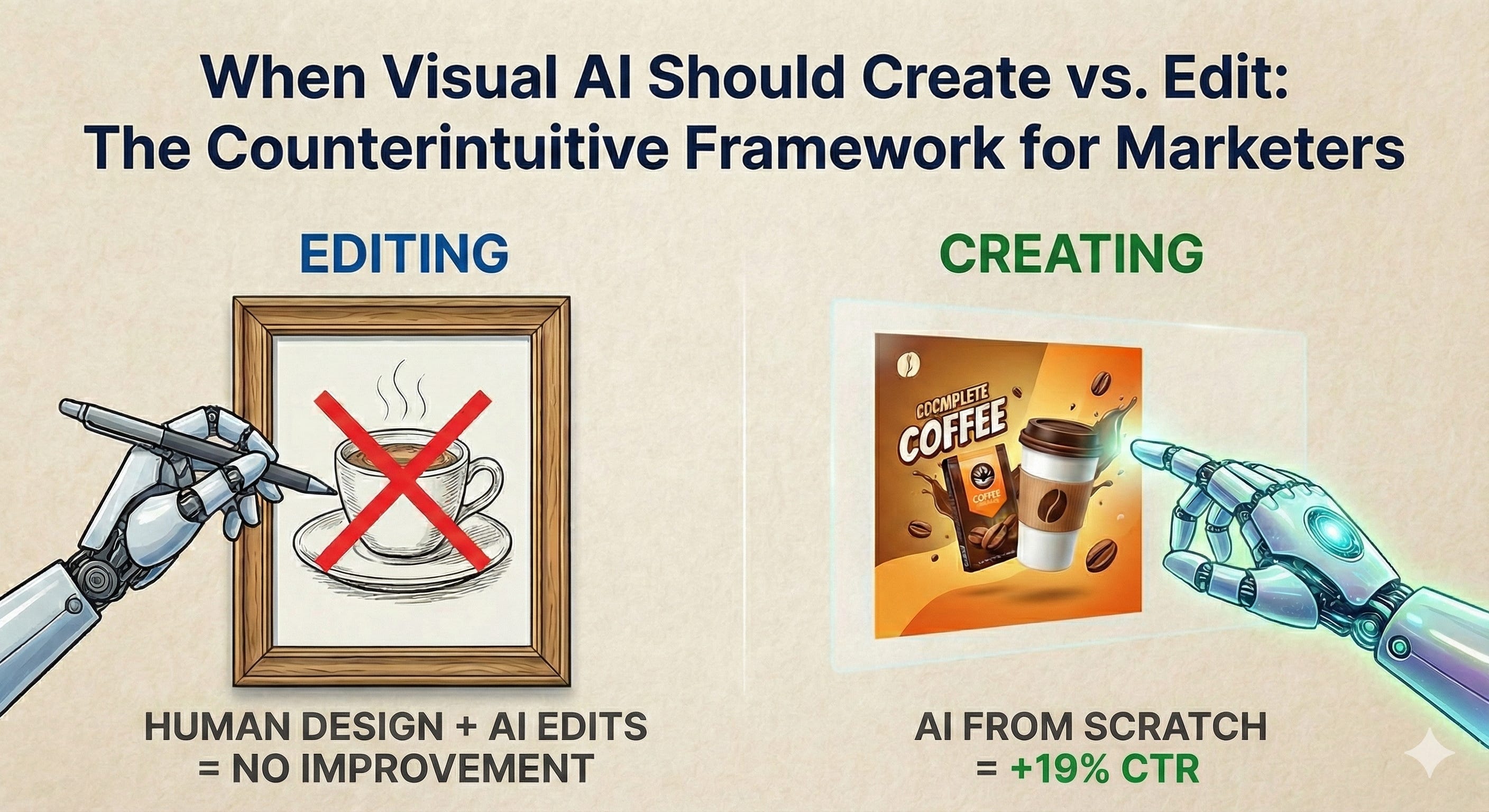
The question isn’t whether to use AI in your advertising; It’s when and how. A major study from NYU Stern and Emory University reveals something counterintuitive about Visual Gen AI: its effectiveness depends entirely on where you place it in the creative process.
Researchers ran both lab experiments and real Google Ads campaigns, comparing human-created advertisements with two types of AI-generated ads. The results? AI-created ads increased click-through rates by 19% when they were made from scratch. But when AI was used to touch up existing human designs? Nothing. No improvement. Sometimes worse.
Think about what that means. Nearly 90% of marketers are now using generative AI, but most are probably using it backwards asking AI to edit and refine when they should be asking it to create.
Sequencing Paradox- Why AI Can’t Edit But Can Create
The difference comes down to creative freedom. When AI modifies an existing ad, it’s working within constraints. It has to preserve the original product, keep the layout, maintain brand consistency. It’s like asking Picasso to touch up someone else’s painting while keeping everything exactly where it is.
But when AI starts from scratch? It builds balanced compositions. It optimizes color contrast. It creates visual hierarchies that make ads easier and more enjoyable to process. The researchers found that AI-created ads trigger stronger emotional responses and feel more authentic, more like real advertisements consumers expect to see.
Here’s the kicker: Visual-based AI is the exact opposite of how text-based AI works. Previous studies showed that ChatGPT and similar tools are better at editing copy than writing it from scratch. Visual AI flips that script entirely. It needs room to breathe.
The Transparency Tax
Now for the uncomfortable part. When the researchers told people that AI had created the ads, effectiveness dropped by 31.5%. Same exact ad. Just added a disclosure label saying “AI-generated.” Boom—> one-third fewer clicks.
This creates a real problem. The White House issued guidelines in 2023 emphasizing that Americans should be able to determine when content is AI-generated, and the European Union’s AI Act now mandates disclosure for certain AI-generated content. Regulations are tightening. But transparency has a price tag attached.
What This Means for Your Marketing Team
Stop using AI as your design intern who fixes layouts and swaps backgrounds. That’s not where it shines.
Instead, bring AI into the room during brainstorming. Use it to generate ten completely different ad concepts in an hour. Let it ideate product packaging. Give it the creative brief and step back. Then → bring in your human experts to refine, optimize, and ensure brand consistency.
The research even showed that when AI designed both the ad and the product packaging shown in it, performance improved even more. Less constraint equals better results.
This framework is especially powerful for smaller companies without big creative budgets. You can now generate professional-quality concepts without hiring an agency. Use AI for the expensive part which is initial creation and then handle the finishing touches in-house. The companies that recognize AI’s true strength in unconstrained creation will have a significant edge.
Do you want to tell your customers if it was AI that made the ad ? The research is clear on that point: transparency and performance are currently at odds. As regulations evolve, marketers will need to find that balance.
Here’s the research
https://papers.ssrn.com/sol3/papers.cfm?abstract_id=5638311
Insightful framework. AI shines in unconstrained creation, not editing. A practical guide for marketers to maximize impact efficiently.
I talk about latest AI trends and insights. Do check out my Substack, I am sure you’ll find it very relevant and relatable.