


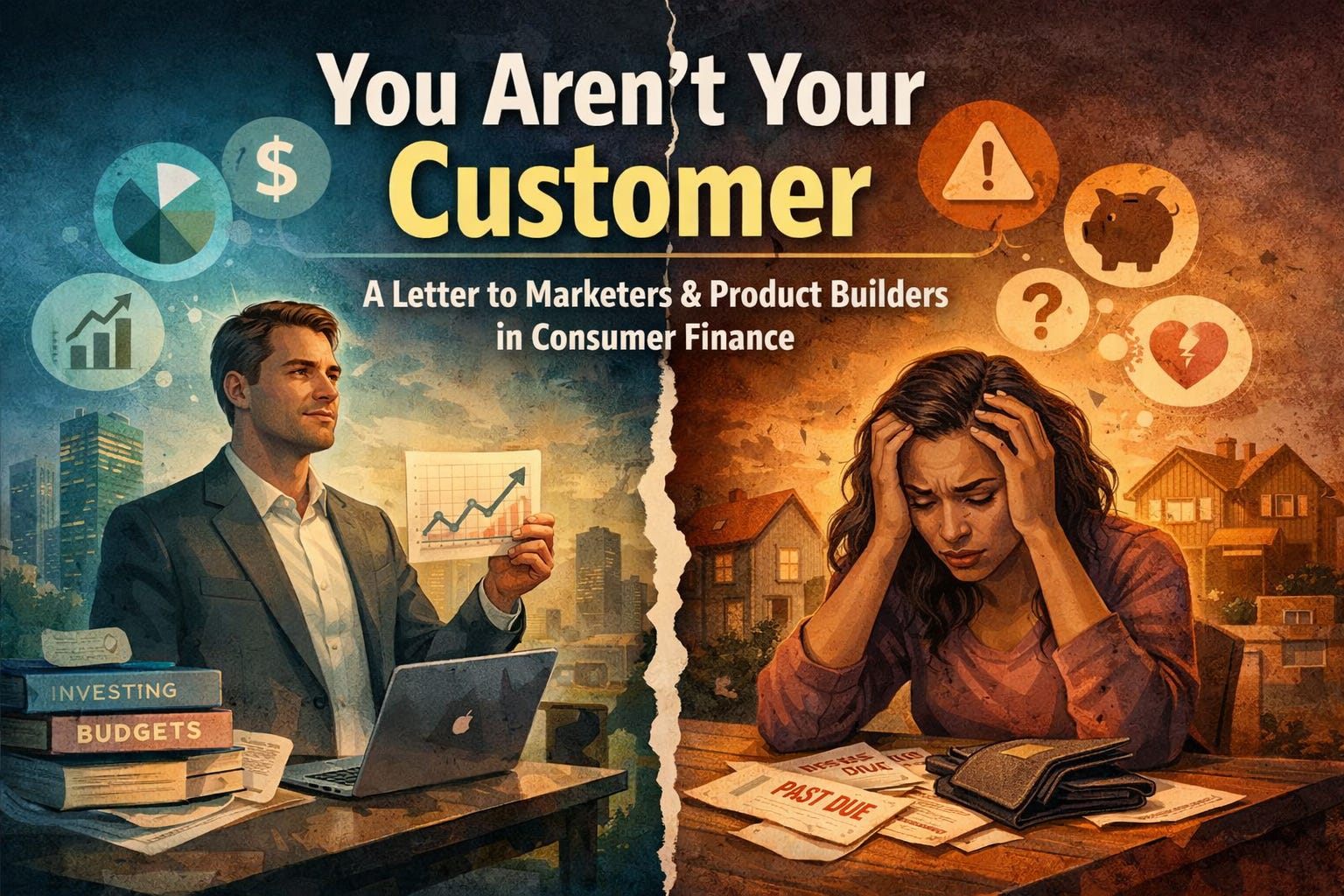
If you are a marketer or product builder in consumer finance, I have some news that might be hard to swallow: You are the outlier.
This is especially true when serving the underserved population left behind by traditional financial institutions
You likely have stable income. You understand compound interest. You grasp the mechanics of asset allocation and fee structures. When you look at a financial dashboard, it’s a roadmap to a goal.
Your customers? Many of them are anxious about money. Not aspirational. Survival-driven. They’re avoiding their finances because looking at the numbers feels like looking into an abyss. They’re operating from a place of profound financial insecurity, and they don’t know what they don’t know.
This gap isn’t just a difference in net worth. It’s a chasm in psychology.
When we build for underserved populations, we often accidentally build for ourselves. Your lived experience is not their reality. It’s easy to mistake your own financial confidence for universal truth. Speaking from personal scars, I’ve spent months advocating for initiatives I found elegant, only to watch users ignore them. I see teams doing this every day with design, UX, and messaging. The caution is always the same: your preferences are not their needs.
The Two Traps of Financial Product Design
Most teams fall into one of two holes when trying to bridge this gap.
The Ego Trap: You project your own preferences onto the product. If you design a feature based on how you would manage wealth, you’re designing for a demographic of one. Your confidence acts as a filter that hides the friction points a struggling user faces. When we assume “they will just get it,” we’ve already lost them.
The Literal Trap: You blindly follow exactly what users say they want. When a customer asks for “flexible terms,” they’re often expressing a visceral need: “I need to survive the next 30 days.” As many great product builders have practiced, the goal is not to ask customers what they want and hand them a hammer. Instead, watch how they struggle and imagine the solution they don’t yet have the vocabulary to describe.
The real mastery is triangulating between the two. Watch what users actually do. Not what they say. Not what you think they should do. What they measurably, actually do.
Understanding the Emotional Barrier
Then dig deeper. Understand the emotional problem underneath the stated need.
Is it anxiety? Avoidance? Distrust? A shame so deep they can’t articulate it? These psychological barriers are often the real barrier, not missing features.
Ask yourself the uncomfortable questions: What are they too ashamed to admit? Where is psychology the actual bottleneck, not technology? What do they desperately need but can’t articulate because they lack the vocabulary or confidence?
Real-World Examples: Psychology Over Features
Consider the “Avoidance Loop.” Behavioral research shows that users with low financial wellness often avoid looking at their balances to escape the immediate pain of a negative number. Traditional banks historically punished this with overdraft fees, which only deepened distrust.
Chime and Dave have illustrated some of this by addressing the psychological barriers. Chime’s SpotMe and Dave’s ExtraCash provide small, fee-free cushions that act as a safety net rather than a trap. Or look at Cleo, the AI assistant that “roasts” or “cheers” your spending. By speaking the language of the user rather than the language of the ledger, they transformed anxiety into genuine engagement.
These companies understand that the problem isn’t a lack of features, but underlying psychology holding the users back.
UX as Emotional Safe Space
Great UX for the customers is about creating an emotional safe space, not displaying more data.
Many successful fintechs have moved away from complex pie charts. Why? Because a pie chart showing 80% of your income going to rent isn’t helpful. It’s a visual representation of failure.
The most effective interfaces focus on Progressive Disclosure and Positive Reinforcement. Instead of showing users everything they’re doing wrong, these apps celebrate “Safe-to-Spend” amounts or “Savings Streaks.” They move the goalposts from “Total Net Worth” (which may be negative) to “Small Wins” (which are achievable). This is psychology-first design. It recognizes that the user is not a robot optimizing a portfolio, but a human trying to navigate a Tuesday.
The Real Problem You’re Solving
Your financial product is not solving a math problem. It’s solving a behavior problem.
The best builders and marketers refuse to be prisoners of their own financial confidence. They don’t assume users are lazy or unsophisticated. They recognize that anxiety isn’t a character flaw. It’s a signal.
When a customer avoids checking their balance, they're not broken. They're protecting themselves from a number that feels like failure. When they ask for flexible terms, they're not asking for a feature. They're asking for breathing room.
You have an advantage: you can see what your customers actually need. Use that to build things that make them feel safe, not smart. Build for the human in front of you, not the version of yourself you see in the data.
That’s the whole game.